SaaSInsightBrowse reviews
Back to all rankings
CybersecurityUpdated August 2026

Best SOC Providers for MSPs in 2026

Key takeaways

  • Vijilan Security is the strongest white-label SOC, channel-exclusive since 2014 with SOC 2 Type 2 and ISO 27001.

  • Huntress publishes the clearest rates.

  • CyberQuell is the only provider anywhere publishing a partner margin table.

  • BitLyft and Field Effect follow on published per-user pricing and MITRE participation.

We ranked security operations providers held in our cybersecurity directory that sell to MSPs, against six weighted criteria: specialisation and fit at 30 percent, commercial transparency at 25, independent validation at 20, client and delivery evidence at 10, tenure at 10 and documented outcomes at 5. Two weights differ from our other cybersecurity rankings and we say so on the page, because reselling a service is a different decision from buying one. Every fact here was taken from the provider's own site, never from another ranking, and a price counts only where the provider publishes it itself. We correct errors once verified, but we do not move a placement on request. Read the full method. No entry on this list is a paid placement.

An MSP buying security operations is not buying security. It is buying something to resell, and that changes every question. What matters is whose name is on the report, what the margin is, whether the contract minimum fits the smallest client you would put on it, and whether the provider will still be your supplier rather than your competitor in three years.

The three delivery models, because the market blurs them

This is the distinction to get right before anything else, and it is the one most rankings in this category skip. Three different things are sold as an MSP SOC:

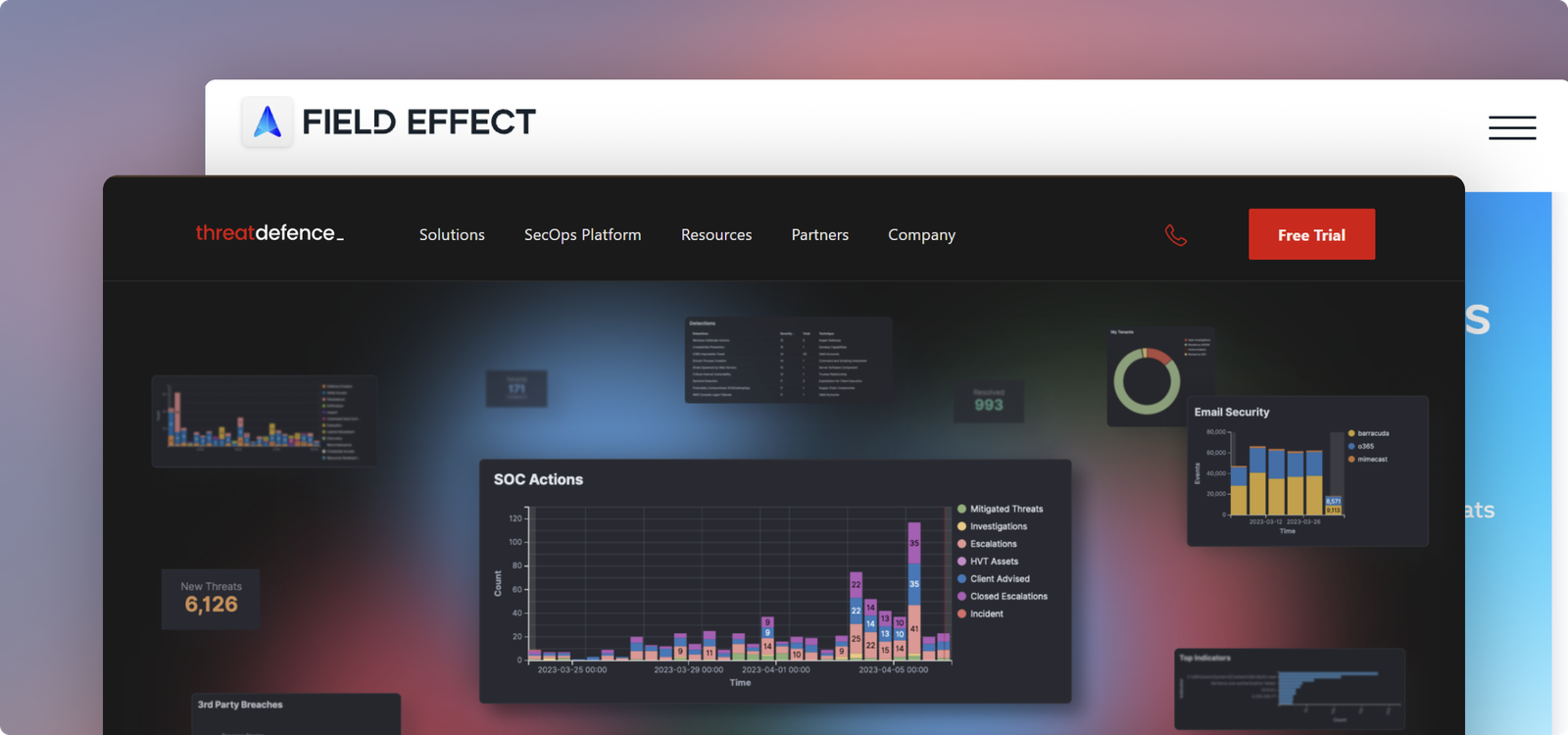
  • White-label · The client sees your brand and only your brand. Portals, reports, alert emails and invoices carry your name. Vijilan Security, ThreatDefence, Cyberleaf, Cyber Solutions and CyberQuell.
  • Co-brand · The client sees both names. CYREBRO is explicit about it, describing the offering as your brand powered by CYREBRO, which is honest and is not the same product.
  • Channel-first · The client sees the vendor's brand. You are a reseller with a margin and a support relationship, not a security practice. Huntress, Blackpoint Cyber, Todyl, Guardz, Field Effect and BitLyft.

None of the three is better than the others. Channel-first vendors are generally the larger, better-evidenced firms, and selling a recognised security brand is a real advantage with a nervous client. But an MSP that signs a channel-first contract expecting to present the service as its own has bought the wrong thing, and that mistake is usually discovered after the first client report goes out.

How we ranked these

We hold 41 cybersecurity providers in our directory. Twelve sell to MSPs and are ranked here, against six criteria weighted as follows.

  • Specialisation and fit · 30% · Whether the firm genuinely serves MSPs, and under whose brand it delivers
  • Commercial transparency · 25% · Whether an MSP can work out its cost, its margin and its minimum commitment before a sales call
  • Independent validation · 20% · Certifications and evaluations from a body with no stake in the result, checked on that body's own page
  • Client and delivery evidence · 10% · Named partners, specific case studies, published research
  • Tenure · 10% · Years operating
  • Documented outcomes · 5% · Published, measurable results rather than a description of the service

Two of those weights differ from our other cybersecurity rankings, and the reason is the buyer. Transparency rises from 10 to 25 because an MSP that cannot establish its cost cannot price the service to its own client, which makes it a gating question rather than a nice-to-have. Delivery evidence falls from 20 to 10 because channel-only providers are contractually barred from naming the partners they serve, so scoring that axis heavily would rank the business model rather than the firm. No score appears anywhere on this page, per firm or per axis.

What these twelve publish, and what they do not

  • A price you can actually build a margin on · Huntress publishes a full per-unit rate card, from $8.99 per endpoint per month. BitLyft publishes $25.99 to $38.99 per user per month. CyberQuell publishes a complete tier table plus the reseller economics, 35 to 50 percent margin per seat against a typical resale price of $7 to $15 per endpoint. Nobody else publishes a number at all.
  • A minimum you have to clear · Huntress requires 50 seats per product buying direct and none at all through an MSP. CyberQuell states 200 endpoints or 50 servers on a one-year term. ThreatDefence says a minimum revenue commitment applies to white-labelling without saying what it is. The rest state nothing.
  • A certification the firm holds itself · Vijilan Security has SOC 2 Type 2 audited annually and ISO 27001, Guardz and Blackpoint Cyber have SOC 2 Type II, Todyl shows an AICPA SOC badge. Field Effect took part in the 2024 MITRE Engenuity ATT&CK Evaluations for Managed Services. The other seven publish none.
  • Who they already serve · Blackpoint Cyber alone, with six named MSP case studies. Everyone else names nobody, and here that is the model rather than evasion, because a channel-only provider naming its partners exposes those partners' suppliers to their clients. It is worth knowing that one firm has cleared it with a dozen.

What this page does not measure

Nothing here observes the thing you are actually buying. No certification watches whether the SOC escalated the alert that mattered at three in the morning, or how a provider behaves in the third year of a contract when your best client asks who is really doing the work. Ask for a partner reference at your size and call it.

The 12 best SOC providers for MSPs, ranked

  1. #01

    Vijilan Security

    Hallandale Beach, Florida, USA

    Vijilan Security logo
    Year established
    2014
    Team size
    11-50
    Pricing model
    Retainer
    Best for
    MSPs that want to sell a security operations centre under their own brand without their supplier ever appearing in front of the client.

    About Vijilan Security

    The strongest record in the white-label block and the only one that publishes enough about itself to be checked. Founded 2014 by KayVon Nejad, headquartered in Hallandale Beach, Florida, and 100 percent channel-exclusive, which it describes as never selling direct rather than as a preference.

    Two products rather than one, and the distinction matters to an MSP. ThreatRespond is a co-managed SOC layered over security tools the partner already owns, so the sunk licence cost survives. ThreatDefend is a fully managed SOC running on CrowdStrike Falcon, which means buying into a stack. The white-labelling is unusually complete: portals, dashboards, executive reports and alert emails all carry the partner's brand.

    SOC 2 Type 2, audited annually, plus ISO 27001 and CrowdStrike CPSP status. That is a materially better credential position than the rest of the white-label field, most of which publishes no certification at all. Pricing runs through a self-service wizard that requires a work email, on a 12-month term with per-user billing, so a partner can size a deal without a call but the rates are not on the open web. Team size is not stated; the site says it keeps a small circle on purpose. The firm also notes it is regularly confused with similarly spelled vendors, so verify the domain before attributing anything to it.

    Rates sit behind a self-service wizard that wants a work email, so a partner can size a deal quickly but cannot compare the numbers against another provider without signing up first. Team size is not published, described only as a small circle kept that way on purpose, which leaves the analyst bench behind the 24/7 commitment impossible to size from outside.


  2. #02

    Huntress

    Columbia, Maryland, USA

    Huntress logo
    Year established
    2015
    Team size
    501–1,000
    Pricing model
    Subscription
    Typical budget
    Managed EDR from $8.99 per endpoint/month, 50-endpoint minimum, 12-month term
    Notable clients
    Boone County Schools, Cohere Health, Kinex Medical Company, Linaro Limited
    Best for
    Small and mid-size businesses, and the MSPs serving them, that want enterprise style detection without running a security team.

    About Huntress

    The most directly relevant record we hold for two of the queued lists: managed SOC for small and mid-size businesses, and white-label or MSP focused SOC. The stated mission is removing the barriers to enterprise level security, the stated buyers are SMBs, MSPs and enterprises, and MSPs and resellers are described as the primary channel. That is exactly the buyer behind those queries.

    The service range is unusually complete for the SMB end of the market, spanning managed EDR, identity threat detection, SIEM, security awareness training and posture management, all wrapped in a 24/7 SOC. Founded 2015. Stated sectors are education, financial services, state and local government, healthcare, law firms, manufacturing and utilities.

    Two caveats. It is a platform sold as a managed service rather than a consultancy, so a buyer wanting bespoke advisory work is not the fit here, and that should be said on any list. And the site names no customers, states no team size, no headquarters and no pricing, so `country` is blank pending confirmation.

    The service is sold under the Huntress name, so a partner is reselling a recognised brand rather than building its own security practice. Buying direct rather than through the MSP route carries a 50-seat minimum per product on a 12-month term.

    Featured work

    • Intelligent Technical Solutions — Managed EDR across a multi-office MSP

      ITS is a Las Vegas managed service provider with around 300 staff, 11 offices and 450+ clients. Huntress Managed EDR flagged malicious activity spreading on a client network at 2am and isolated the affected hosts. ITS reports incident response dropping from two to three weeks down to two to three hours. The case shows Huntress operating at MSP scale where alert quality, not alert volume, is the constraint.

      • Managed EDR
      • MSP
    • Ultra IT — Managed ITDR, EDR and Security Awareness Training across 230 tenants

      Ultra IT is a New Zealand MSP running Huntress across 230 client tenants. Huntress ITDR caught a business email compromise — a server login from Indonesia paired with command-line Azure activity — and blocked access before fraudulent invoices went out. It demonstrates identity-layer detection working in Microsoft 365 estates, not just on endpoints, and shows the service operating outside North America.

      • Managed ITDR
      • Microsoft 365
    • Key Methods — Managed EDR plus Managed SIEM across 2,000+ endpoints

      Key Methods is a Washington State MSP covering 2,000+ endpoints for nearly 80 clients. Running EDR and SIEM together let its team scope a factory incident from logs the same day rather than over several days, and avoid bringing in third-party incident response and legal counsel. The case is evidence that the SIEM product is used in anger, not just sold alongside EDR.

      • Managed SIEM
      • Incident Response
  3. #03

    CyberQuell

    Dubai, United Arab Emirates

    CyberQuell logo
    Year established
    2024
    Team size
    2–9
    Pricing model
    Retainer
    Hourly rate
    $50 – $99/hr
    Typical budget
    White-label SOC from $1,488 per month, minimum 200 endpoints or 50 servers
    Notable clients
    Health Analytics Connect
    Best for
    MSPs that need a SOC to resell under their own brand at a known cost, and UAE or wider Gulf mid-market organisations standardised on Microsoft security tooling.

    About CyberQuell

    The most precisely targeted record in the category against our queued titles, and the only firm found that names two of them as services outright. GoDaddy Microsoft 365 defederation is listed explicitly, which no other provider in this set mentions at all despite six of them being shortlisted for that topic. White-label SOC for MSPs is likewise named directly rather than implied by a partner programme. Where competitors had to be interpreted, this one states it.

    It is also the only firm in 35 to publish white-label pricing in full, and by some distance the most transparent commercial disclosure in the category. Three tiers: Watch, managed monitoring, from $1,488 a month at $3.12 per endpoint on a $864 base fee; Defend, full SOC operations, from $2,400 a month at $4.80 per endpoint on a $1,440 base fee, with servers at $12 each on an $840 base; and MXDR, a dedicated SOC team, scoped per engagement. Both base fees are waived when servers are included. Minimum billing is 200 endpoints or 50 servers on a one year term, with no setup fees stated. All tiers include 24/7 analyst monitoring, white-labelled reports, a 15 minute response SLA and a 99.9% uptime guarantee.

    Unusually for this market it also publishes the reseller economics: 35 to 50% margin per seat against a typical resale price of $7 to $15 per endpoint, with a worked example of 500 endpoints and 50 servers returning $2,660 a month at 41%. For an MSP reader that is the actual buying decision, and no competitor sourced so far discloses anything comparable.

    Dubai headquarters, which makes this the fourth UAE record and a candidate for the regional list as well as the MSP and Microsoft ones. Delivery is built on the Microsoft stack throughout, Sentinel for SIEM, Defender for endpoint and email, Intune for devices.

    Founded in 2024, so it has the shortest operating record here, and the SOC 2, ISO 27001, HIPAA and PCI DSS references on the site are frameworks it helps clients meet rather than audits it has passed. One named client. The published minimum of 200 endpoints or 50 servers on a one-year term rules out the smallest MSP book.

    Featured work

    • Emergency Microsoft 365 Tenant Defederation from GoDaddy

      A 200-mailbox law firm was moved off a GoDaddy-managed Microsoft 365 tenant to a directly owned tenant in four hours with no reported email downtime. The write-up shows the team can run a time-boxed identity and tenant-ownership migration on a live mail platform rather than only monitoring one. Defederation is a specific, awkward Microsoft admin problem and this is the service CyberQuell markets most heavily.

      • Microsoft 365
      • Identity
    • Investigating a Multi-Phase Business Email Compromise Campaign

      A four-month business email compromise involving stolen session tokens, OAuth app persistence and malicious Outlook rules, ending with no reported financial loss. The account traces the attacker's persistence mechanisms rather than stopping at the initial phish, which is the harder half of BEC work. It is the clearest evidence on the site of hands-on incident response depth.

      • Incident Response
      • Microsoft 365
    • White-Label SOC Partnership for a Managed Service Provider

      An MSP was set up to resell monitored security under its own brand within 30 days, reported as $12,400 monthly recurring revenue across 40+ downstream clients. It demonstrates CyberQuell can operate as a wholesale SOC behind another provider, not only sell direct. Useful signal for buyers who are themselves IT providers rather than end customers.

      • SOC
      • White-label
  4. #04

    BitLyft

    St. Johns, Michigan, USA

    BitLyft logo
    Year established
    2016
    Team size
    11–50
    Pricing model
    Retainer
    Typical budget
    $25.99 to $38.99 per user per month
    Notable clients
    UMBRAGROUP
    Best for
    Mid-market organisations in utilities, banking and consumer goods wanting automation led detection and response rather than headcount led monitoring.

    About BitLyft

    The distinguishing feature is automation rather than analyst hours, and specifically BitLyft AIR, an automated incident response product aimed at Microsoft 365. That makes the record useful to the Microsoft focused lists as well as the mid-market SOC ones, and it is a different argument from the human led positioning most competitors lead with.

    Stated target is mid-market, with public utilities, banking and consumer packaged goods named as sectors. Public utilities is a notable specialism, since operational technology environments have requirements most general MDR providers do not meet, and it is worth checking whether that depth is real.

    The reason to rank this highly is the pricing page, which is the only genuine published rate card found in the entire category. Three tiers are named with figures attached: Basic at $25.99 per user per month, Plus at $30.99 and Premium at $38.99, billed monthly or annually on a 12 or 36 month commitment, subject to a minimum number of users which is not disclosed. Vulnerability scanning is priced separately by device count and frequency, and onboarding is quoted after a scoping call.

    That transparency is what makes the budget constrained lists writable. At the Basic rate a $5,000 a month ceiling buys roughly 190 users, which is a concrete answer to a question every competing article dodges. The undisclosed user minimum is the one caveat and should be established before the figure is used to make a recommendation to smaller buyers.

    No headquarters, founding year, team size or named customers is stated on the pages read, so `country` is blank and the record cannot serve a location filtered list. The partners page was not reachable, so whether this belongs on the white-label list is still unsettled.

    The rate card is subject to an undisclosed user minimum, so the entry point is unknown despite the prices being public. Partner materials are co-branded, so this is not a route to presenting the SOC as your own, and no margin figure is published anywhere.

    Featured work

    • UMBRAGROUP — Department of Defense supplier

      UMBRAGROUP manufactures ball screws for the US Department of Defense across plants in Italy, Germany and the United States, and ran with a small internal security team. BitLyft's onboarding located log sources the client had not mapped, then found and corrected misconfigurations in its Microsoft 365 security settings. The SOC later flagged successful logins on a dormant account and had the access removed. It shows BitLyft handling a CUI-handling manufacturer with plants in three countries, and doing discovery work rather than only alert triage.

      • MDR
      • SOC
      • Manufacturing
      • Defense
    • BitLyft True MDR

      BitLyft's core managed detection and response package, bundling SIEM log ingestion across network, endpoint, cloud and application layers with a 24/7/365 SOC staffed by US-based Tier 3 analysts, security automation and its own threat intelligence feed. Each account gets a named lead engineer and unlimited incident response. The scope covers EDR, NDR, CDR and XDR telemetry rather than a single detection surface.

      • MDR
      • SIEM
      • SOC
    • BitLyft AIR®

      BitLyft's own automated incident response platform, marketed as a no-code autonomous SOC layer that sits under the managed service. It is the piece that lets a team of this size cover round-the-clock response without a proportionally large analyst roster, and it means BitLyft is selling software it builds rather than only reselling a third-party stack.

      • Security automation
      • Incident response
      • Product
  5. #05

    Field Effect

    Ottawa, Ontario, Canada

    Field Effect logo
    Year established
    2016
    Team size
    51–200
    Pricing model
    Subscription
    Notable clients
    Business Cloud Inc., Sera Brynn, Intelligent Technical Solutions, The Private Network
    Best for
    MSPs that need a detection and response capability to deliver to their own clients, and smaller IT teams without a security function.

    About Field Effect

    Directly relevant to the MSP channel cut, which is the harder of the two SMB lists to source. The site presents distinct routes for IT teams and for MSPs and names an MSP partner programme explicitly, and tellingly the named customers are themselves service providers, with Intelligent Technical Solutions and Business Cloud both being MSPs rather than end users. That is good evidence the channel is real rather than aspirational.

    What it does not say is whether the service is rebrandable. A partner programme and a white-label SOC are different products, and the list title turns on that distinction, so it needs establishing directly before this record carries a white-label claim.

    The corporate entity is Field Effect Software Inc., headquartered at 979 Bank Street in Ottawa, and the product is a platform sold with a managed service around it rather than a consultancy. Canadian rather than American, which is worth noting because it is frequently listed among US providers. No founding year, team size or pricing is stated.

    The partner page describes product discounts without publishing a figure, and states nothing about what a partner can rebrand, so both the margin and the branding have to be established in the partner agreement rather than in advance.

    Featured work

    • Terra Firma Capital Partners — MDR for a 70-person private equity firm with no in-house security team

      A London private equity firm that has invested €17 billion across 34 businesses moved to hybrid working and needed 24/7 cover across endpoints, cloud services and networks without building a security function. The engagement shows Field Effect operating as the whole security capability for a small, high-value organisation rather than as an add-on to an existing SOC. The customer reports investigation of a possible compromise dropping from a full day to minutes and around 75% time saved, and notes pricing was charged by user rather than per endpoint or per instance.

      • MDR
      • Private Equity
      • Hybrid workforce
    • Intelligent Technical Solutions — standardising security across an MSP's client base in 13 US cities

      An MSP of 25+ years replaced a patchwork of security vendors with a single platform covering endpoint, cloud and network across its whole client base. It demonstrates the partner side of the business: delivery that a third party resells and operates at multiple client sites, including junior technicians acting on the ARO alert format without escalation. Field Effect also built the lower MDR Core tier in response to this partner's need for budget-constrained clients, which shows the packaging is shaped by MSP economics.

      • MDR
      • MSP partner
      • Multi-tenant
    • Ottawa Sports and Entertainment Group — post-ransomware monitoring for an IT team of five

      OSEG, which runs the CFL REDBLACKS, the OHL Ottawa 67s and Lansdowne Park, brought Field Effect in after a ransomware attack during which it took hours to locate the infected machine. The work shows detection and patch visibility being handed to a five-person IT department covering 85 staff and public venue infrastructure. Reported outcomes are 100% visibility of threats and vulnerabilities, 90% time saved on incident response and 70% on patch management.

      • MDR
      • Incident response
      • Sports
  6. #06

    Blackpoint Cyber

    Blackpoint Cyber logo
    Year established
    2014
    Pricing model
    Retainer
    Best for
    MSPs that want a SOC which acts on a threat rather than forwarding an alert, and can sell it under a security brand their clients recognise.

    About Blackpoint Cyber

    The best-evidenced provider in the MSP channel and the one that most clearly separates responding from alerting. Founded in 2014 by former NSA and military operators under CEO Jon Murchison, with the whole platform, CompassOne, built around a 24/7 SOC that takes action rather than escalating, which is the distinction most of this market blurs.

    The client evidence is the standout and it is unusual for the category. Six named MSP success stories are published, including STF Consulting, Responsive Technology Partners, R3, Interlaced and BECA Corp, alongside attributed testimonials from Premier One, Liberty Technology, Blue Alliance and Covenant Technology Solutions. Almost every other provider selling through the channel names nobody at all, because doing so exposes a partner's supplier to that partner's clients, so a firm that has cleared this with a dozen partners has done something the rest have not.

    The delivery model is channel-first rather than white-label. The partner programme is tiered, with a portal, enablement material and early product access, and the language throughout is an extension of your team. No page on the site claims the service can be sold under the partner's own brand, so an MSP wanting its own name on the report should confirm that in the partner agreement rather than assume it.

    SOC 2 Type II, stated as an annual compliance, plus GDPR. Support runs from North America, Australia and the United Kingdom. Nothing commercial is published: no price, no minimum seat count and no partner margin, so the resale economics can only be established through a sales conversation. No headquarters address appears on the site either, only regional phone numbers.

    Publishes no price, no minimum seat count and no partner margin, so the resale economics can only be established in a sales conversation, and no page claims the service can be sold under your own brand.

  7. #07

    Guardz

    Guardz logo
    Pricing model
    Retainer
    Best for
    Smaller MSPs serving small business clients who want one platform rather than a separate SOC contract.

    About Guardz

    Explicitly built for MSPs rather than adapted for them: the homepage positions the whole platform as agentic security operations for MSPs, and the integration list is the tell, covering ConnectWise, Syncro, SuperOps and Pax8, which is the tooling a small MSP actually runs rather than the enterprise stack.

    Unified MDR with 24/7 detection and response is the core, wrapped around email, identity, endpoint and cloud in one subscription. SOC 2 Type II is held and displayed. The commercial shape is friendlier than most of this field, with per-seat pricing, a stated no-gotcha all-inclusive position and a 14-day trial, though no actual rate is published.

    Two gaps to close before a confident placement. Whether the service can be delivered under the MSP's own brand is not stated anywhere public, so it belongs in the channel-first group rather than the white-label one until confirmed. And the site states no founding year, no headquarters and no team size, so the only independent credential is the SOC 2 Type II attestation and a G2 High Performer badge, which is a user-review programme rather than an evaluation.

    No founding year, headquarters or team size appears anywhere on the site, so the company behind a 24/7 commitment cannot be sized from public sources. The per-seat rate is never published despite an all-inclusive pricing claim, and whether anything can carry your brand is not addressed.

  8. #08

    CYREBRO

    Tel Aviv, Israel

    CYREBRO logo
    Year established
    2013
    Team size
    51–200
    Pricing model
    Subscription
    Notable clients
    AudioCodes, Delta Capita, Infinigate, Rivulis, Labrie Environmental Group, Black Gold School Division
    Best for
    Smaller organisations wanting SOC coverage without building one, and MSPs or MSSPs that need a SOC capability to resell.

    About CYREBRO

    Relevant to the MSP and white-label cut because it explicitly segments its offering three ways, for micro businesses and SMBs, for enterprises, and for MSSP and MSP partners. That partner track is the reason to hold the record, even though the site does not use the phrase white-label anywhere, so whether it is genuinely rebrandable needs checking directly rather than assumed.

    Positioning is AI native MDR with 24/7/365 monitoring, and the service list is broad for this segment, including forensic investigation and incident response alongside monitoring. The named customer logos are a mix of telecom, industrial and education, with AudioCodes and Delta Capita the most recognisable.

    Like the other MDR records in this batch it is platform led rather than consultancy led. No headquarters, founding year, team size or pricing is stated, so `country` is blank. Confirming the base matters here more than usual, since one of the queued lists is region specific.

    The offering is co-branded by design, described as your brand powered by CYREBRO, so the client sees both names. That is the right choice for an MSP that wants a recognised platform behind it and the wrong one for an MSP building its own security brand.

    Featured work

    • Ransomware attack prevented at a global manufacturer

      Published incident response case study covering a manufacturer with 5,000+ employees and over $1bn annual revenue. It shows CYREBRO working an active ransomware incident end to end — scoping the compromise, identifying root cause and driving eradication — on an estate large enough to have multiple sites and legacy OT-adjacent systems. Useful evidence that the SOC handles live incidents, not just alert triage.

      • Incident Response
      • Manufacturing
    • Visibility programme for a US hedge fund

      Case study on a top US alternative-investment hedge fund with holdings across financial, telecom, healthcare and industrial sectors. The engagement is about establishing continuous visibility of security events across a regulated, low-tolerance environment rather than deploying new tooling. Indicates CYREBRO can work inside financial-services controls and reporting expectations.

      • Strategic Monitoring
      • Financial Services
    • Incident Response capability

      A named, separately documented service rather than a bundled extra. CYREBRO states 24/7/365 analyst availability, direct analyst communication inside its platform, and live visibility into an investigation as it runs. The stated advantage is that analysts already hold the customer's network topology, so investigation starts without a discovery phase. No SLA figures are published on the page.

      • Incident Response
      • DFIR
  9. #09

    Cyberleaf

    Cyberleaf logo
    Pricing model
    Retainer
    Best for
    MSPs whose clients need US-based analysts and compliance reporting without the MSP building a security practice.

    About Cyberleaf

    A straightforward white-label proposition with one useful operational number attached. The SOC is described as fully staffed, 24/7 and US-based, consolidating endpoint, cloud, network, email and identity telemetry into an integrated SIEM, and the company states it resolves 97 percent of alerts without escalating to the partner. Whether or not that figure is auditable, it is at least the right metric to publish, because escalation volume is what decides how much work an MSP inherits.

    Compliance reporting is aimed at the frameworks a small US buyer actually faces, SOC 2, HIPAA, CMMC, NIST 800-171 and cyber insurance requirements, which is a narrower and more useful list than the everything-covered claim common in this market.

    The commercial claim is oddly shaped and should be tested. The site says pricing is predictable and per-client, with no data ingestion fees and no minimum commitments that do not make sense, then publishes no figure at all, so the predictability is asserted rather than demonstrated. No founding year, headquarters, team size, named customer or certification appears on the partner page, so the record rests almost entirely on the firm's own description of its service.

    The 97 percent escalation figure is self-reported with no stated methodology or period, so read it as the right metric rather than a verified one. Pricing is described as predictable and per-client and then no figure appears anywhere, so the predictability is asserted rather than shown.

  10. #10

    Todyl

    Denver, Colorado, USA

    Todyl logo
    Year established
    2015
    Team size
    201-500
    Pricing model
    Retainer
    Best for
    MSPs that would rather consolidate several security vendors into one platform than assemble a stack per client.

    About Todyl

    Founded in 2015 by John Nellen, with the platform arriving in stages: SASE and SIEM in 2020, EDR and MXDR in 2022, a Denver headquarters in 2023, an Augusta, Georgia office and a $50 million Series B in 2024. The funding and the office expansion are the clearest evidence of scale in the MSP-channel block, most of which is privately held and silent about size.

    Channel-only, and stated as a belief rather than a routing decision: the company says the best cybersecurity comes through trusted partners. What it does not say anywhere on its public pages is that the service can be sold under the partner's own brand, which is the distinction an MSP shopping for a white-label SOC actually needs. Treat it as channel-first rather than white-label until the partner agreement says otherwise.

    The commercial position is opaque. No pricing, no minimums and no margin figures appear anywhere public, and every route is a request-pricing form. Recognition is the weak spot for a page that only accepts independently judged credentials: an AICPA SOC badge is the only real one, and the Inc. 5000, Deloitte Fast 500, Cyber 150 and G2 badges it displays are growth rankings and user-review programmes rather than evaluations of the security service.

    No pricing, minimum or margin figure is published anywhere, so an MSP cannot begin to model the resale economics without a sales conversation. Most of the recognition on display is the wrong kind for judging a security service: Inc. 5000 and Deloitte Fast 500 rank growth, and the G2 badges are user reviews.

  11. #11

    ThreatDefence

    ThreatDefence logo
    Pricing model
    Retainer
    Best for
    MSPs and MSSPs that want to operate the SOC themselves rather than outsource the analysts, while presenting it entirely as their own.

    About ThreatDefence

    The most literal reading of white-label in this pool, and structurally different from the rest of it. Where the other white-label providers supply analysts who work behind the partner's brand, ThreatDefence supplies the platform and the branding and leaves the operating model open: a partner can use the hosted SaaS with its own branding, or run its own instance anywhere it likes. For an MSP intending to build a security practice rather than resell one, that is a different and better-fitting proposition.

    The qualification terms are stated plainly, which is rarer than it should be here. White-label deployment requires being an authorised reseller or MSSP under a commercial agreement, and the company says there are minimum revenue commitments attached. It does not publish what they are, so the one number that decides whether a small MSP can use this at all is the number missing.

    Nothing about the company itself is public on the pages read: no founding year, no headquarters, no team size, no named customers and no certifications. For a platform a partner would run its entire security practice on, that is a thin basis, and the certification position in particular should be established directly before committing.

    White-labelling carries a minimum revenue commitment that is named but never quantified, which is the single number deciding whether a smaller MSP can use it at all. Because the partner runs the platform, the analyst capability stays your problem, so this is not a route to 24/7 cover for an MSP with no security staff.

  12. #12

    Cyber Solutions

    Anderson, South Carolina, USA

    Cyber Solutions logo
    Pricing model
    Retainer
    Best for
    MSPs that want to add a security practice without migrating clients off the tooling they already run.

    About Cyber Solutions

    The most concrete of the small white-label firms on the two things an MSP owner asks first. Reports, dashboards and every customer-facing deliverable carry the MSP's branding rather than the supplier's, and the response commitment is stated as under an hour, which is a number to hold someone to rather than a description.

    Two further terms are unusual enough to be worth naming. It commits to no tool migration, so an MSP is not forced to move clients onto a vendor stack as the price of the partnership, which is the hidden cost in most of this market. And it offers a mutual non-solicitation agreement, which addresses the fear that actually stops MSPs outsourcing security: that the supplier eventually sells to the client directly. A 90-day launch timeline is quoted, against documented runbooks and existing tooling.

    What is missing is everything about the firm. No founding year, no team size, no named client, no certification and no pricing appear on the page, and the only public anchor is an Anderson, South Carolina address and a phone number. The name is also generic enough to collide with unrelated companies, so tie any fact to the discovercybersolutions.com domain rather than to the name.

    The only public anchors are an Anderson, South Carolina address and a phone number, so almost nothing can be checked independently before a call. The sub-hour response commitment is stated rather than backed by a published consequence for missing it.

How to choose the right provider for you

The ranking says which providers are strongest against our criteria. It does not say which one fits your book. Route by your hardest constraint.

By what your client should see

  • Your brand only. CyberQuell if the margin arithmetic has to work out before you sign, Vijilan Security if you want the certifications too, ThreatDefence if you would rather run the platform yourself, Cyberleaf or Cyber Solutions if a US-staffed SOC and a straightforward partnership matter more than the paperwork.
  • Both brands. CYREBRO, which is the only one honest enough to describe the model in those words.
  • The vendor's brand, and that is fine. Huntress, Blackpoint Cyber, Field Effect, Todyl, Guardz or BitLyft. Selling a security brand your client has heard of is a real advantage, and these are the better-evidenced firms.

By the size of your smallest client

Minimums decide this, not price. Huntress mandates none through the MSP route, which is the friendliest entry point on the page for a book of very small clients. CyberQuell's floor of 200 endpoints or 50 servers is aimed at an established book rather than a first security client. BitLyft's minimum exists but is not published, and ThreatDefence's white-label revenue commitment is stated without a figure, so both need establishing in the first email rather than the third meeting.

By whether you want a practice or a product

A product is faster: you resell, you take a margin, the vendor owns the capability. A practice is slower and worth more, because the client relationship and the detection content stay with you. ThreatDefence is the clearest route to a practice, Vijilan sits in between with a co-managed option over tools you already own, and the channel-first vendors are firmly a product.

The questions worth asking whoever you shortlist

What exactly is rebrandable, and can I see a sample report? Rebranding a portal is not rebranding an alert email or an invoice, and the gap is where your client finds out.

What is your non-solicitation position? The fear that stops MSPs outsourcing security is that the supplier eventually sells direct. One provider here puts it in writing. Ask the rest.

What is the minimum, and does it apply per client or across my book? The same number means very different things and almost nobody states which.

What happens to the detections and the tuning when I leave? If the content you paid to develop goes with the vendor, you have been renting your own security practice.

Frequently asked questions

What is the difference between a white-label SOC and a co-branded one?

A white-label SOC appears entirely as yours: the portal, the reports, the alert emails and the invoice carry your name and your client never learns who runs it unless you choose to say. Co-branding puts both names in front of the client, usually framed as your service powered by the vendor. The difference matters commercially rather than technically. White-label protects the client relationship and lets you price on your own value; co-branding borrows the vendor's credibility, which is worth something with a nervous client and costs you the ability to swap suppliers quietly. Ask specifically what is rebrandable, because a provider can white-label a dashboard and still send alert emails from its own domain.

What margin should an MSP expect on a resold SOC?

Almost nobody publishes one, so the honest answer is that you will have to ask. The single public data point in this market is CyberQuell, which states 35 to 50 percent per seat against a typical resale price of $7 to $15 per endpoint, and works the example through at 500 endpoints and 50 servers. Treat that as one provider's published position rather than a market rate. When you ask, establish whether the margin is on list or on your actual cost after minimums, because a strong headline percentage against a minimum you cannot fill is a worse deal than a smaller one you can.

Do I have to move my clients onto the provider's tools?

Sometimes, and it is the cost most MSPs miss when comparing quotes. A fully managed SOC on the provider's own stack means migrating clients and writing off licences you have already bought. A co-managed model runs over the tooling you own instead. Vijilan sells both shapes separately for exactly this reason, and Cyber Solutions commits to no tool migration outright. If your clients are on Microsoft E5 or an EDR you resell today, price the migration before you compare the monthly figures, because it can dwarf the difference between two providers.

What stops my SOC provider from selling to my clients directly?

Contractually, usually nothing, which is why this is the question MSP owners raise first. Two things reduce the risk. A channel-exclusive provider that has never sold direct has structurally less incentive to start, and Vijilan describes itself that way. Failing that, ask for a mutual non-solicitation agreement in writing; Cyber Solutions offers one, which suggests it is negotiable elsewhere. A provider that will not put anything in writing is not necessarily planning to compete with you, but it is asking you to introduce it to your entire client base on trust.

What certifications should I require from a SOC provider?

At minimum, a certification the provider holds itself rather than one it helps clients achieve, and the two blur constantly in this market's marketing. SOC 2 Type II is the useful floor because it covers a period of operation rather than a moment, and ISO 27001 alongside it is better. Vijilan holds both, Guardz holds SOC 2 Type II. Be careful with the rest of what gets displayed: growth rankings, magazine awards and user-review badges are not audits of a security service. If you carry SOC 2 or similar obligations to your own clients, your supplier's audit position becomes part of yours, so ask for the report rather than the badge.

Is a white-label SOC worth it if I already have an engineer who watches alerts?

Round-the-clock cover is the thing one engineer cannot give you. Staffing 24/7 properly takes roughly five to six analysts once holiday, attrition and burnout are counted, in one of the hardest hiring markets there is, so the choice is rarely between a partner and your engineer. It is between a partner and having nobody awake at three in the morning. What your engineer gives you that a partner cannot is context, knowing which server is load-bearing and which alert is the same false positive as last week. The co-managed models exist for exactly that shape, keeping your engineer in the loop rather than replacing them.

Popular alternatives

When the obvious choice stops fitting

See what teams switch to, and whether the move is actually worth making.

All alternatives
AI search visibilityUpdated 24 Aug

Profound alternatives

Nine alternatives ranked by the Profound limit that sent you looking: the $399 for three engines, the single seat, the missing API, or the unpriced Enterprise tier. Plus the one thing none of them replaces.

Not sure which model fits your book?

Tell us how many endpoints you would put on the service, whether your clients need to see your brand or the vendor's, and what your smallest client looks like. We will point you at the two or three providers in our directory that genuinely match.

Get matched with a provider

SaaSInsight is funded by labelled placements and affiliate links. Ranking position is editorial and is never for sale. Read our disclosure policy.