SaaSInsightBrowse reviews
Back to all rankings
CybersecurityUpdated September 2026

Best Cloud Incident Response Firms Under $5,000 a Month

Key takeaways

  • Huntress leads at about $1,160 a month for a hundred seats with 24/7 response in every product.

  • Blumira publishes the cleanest rate card, $16 to $21 per employee.

  • ThreatDown is cheapest but self-serve only to twenty devices, and CyberQuell publishes its partner rate card in full and scopes direct work.

  • The cap is a headcount, not a price.

We scored every provider in our cybersecurity pool that publishes a price and includes 24/7 detection and response, against the six criteria published at /methodology, weighted for a question that turns on price: commercial transparency 25, specialisation and fit 25, independent recognition 15, client evidence 15, tenure 10, documented outcomes 10. Transparency acts as a gate before it acts as a weight: a firm with no published price is not on the page, which is why there are four entries rather than our usual nine or more. Read the full method. No entry on this list is a paid placement.

The question behind this page is usually asked in one breath: a cloud security specialist with real incident response, for under five thousand dollars a month. The honest answer starts by naming what that buys. It does not buy an incident response firm of the retainer kind. Those publish nothing and price above it. What it buys is managed detection and response, a platform with a 24/7 team behind it that watches your endpoints and your Microsoft 365 or Google identities, and acts when something happens. Every firm below is that, and every one publishes a price.

Which leads to the second thing to know. Under $5,000 a month is not a price. It is a headcount. All four price per user, per endpoint or per identity, so the cap is crossed at a company size, and that size differs threefold between them. This page assumes a hundred seats, states what each firm costs at that size, and states the size at which each one crosses $5,000. That arithmetic is the whole page, and nobody else on this search does it.

How this list was built

Six criteria, the same six behind every SaaSInsight ranking, weighted for a question that turns on price. Full definitions are at /methodology.

  • Commercial transparency · 25 · A gate before it is a weight: no published price, not on the page. Then, whether the unit, the minimum and any ceiling are stated
  • Specialisation and fit · 25 · Response genuinely included around the clock, and cloud identity coverage named rather than implied
  • Independent recognition · 15 · Reviews, analyst coverage and partner standing
  • Client evidence · 15 · Named customers on the firm's own site
  • Tenure · 10 · How long the service has been shipping
  • Documented outcomes · 10 · Named cases with a figure

What these four publish, at a hundred seats

  • Huntress · Managed EDR at $7.99 per endpoint plus identity protection at $3.60, both stated at 100 units · about $1,160 a month · crosses $5,000 at roughly 430 seats · no minimum through an MSP, 50 per product through a reseller
  • Blumira · $16 per employee for Respond, $21 for Automate · $1,600 to $2,100 a month · crosses $5,000 at 238 employees on Automate, 312 on Respond · annual contract
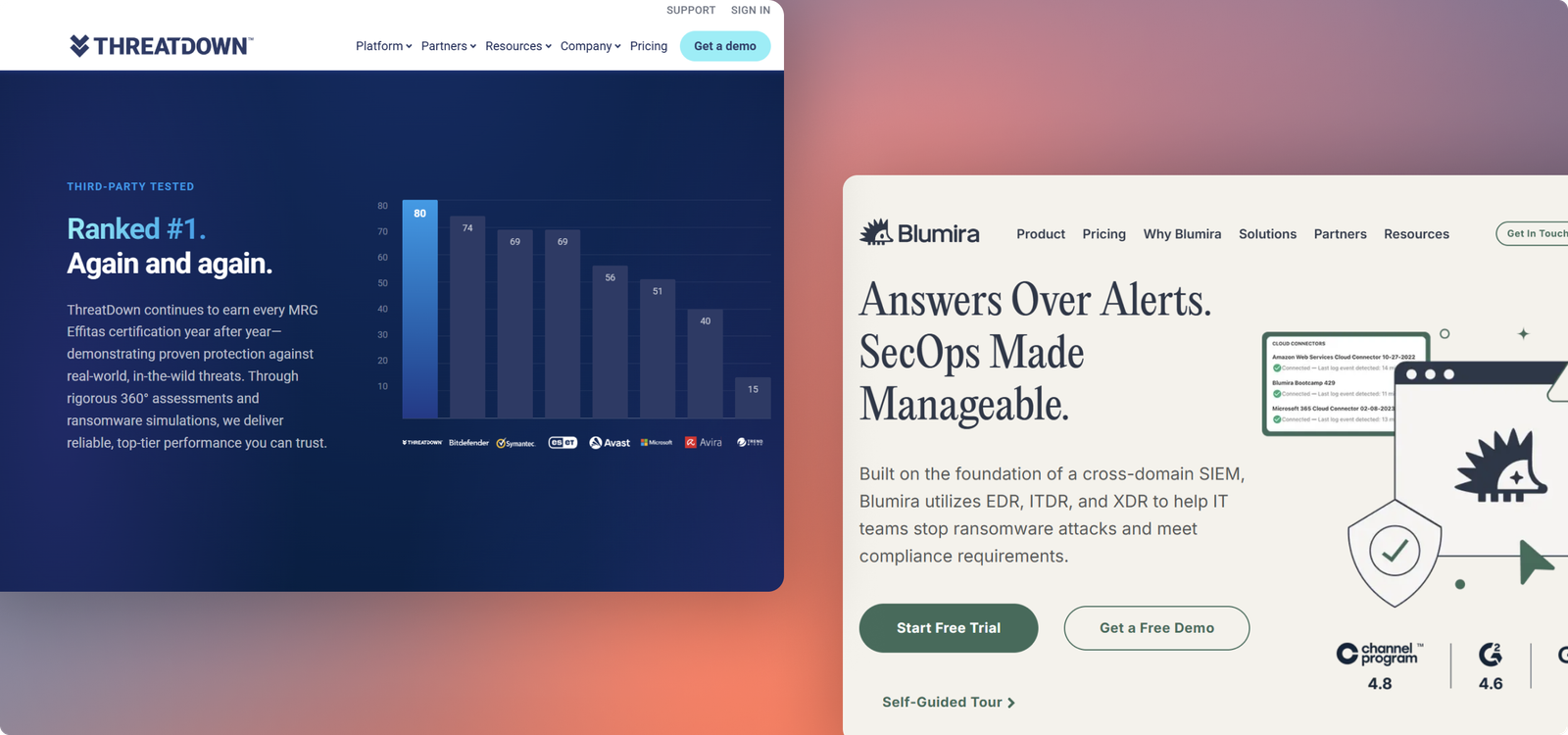
  • ThreatDown · Elite MDR at $99 per device per year, $8.25 a month · $165 a month for twenty devices, and a hundred is a quote · the self-serve selector stops at 20
  • CyberQuell · Defend at a $1,440 base plus $4.80 per endpoint, published as partner rates with a 200-endpoint floor · $2,400 a month at that floor; direct engagements are scoped, with no figure on the site · the partner rate crosses $5,000 at roughly 740 endpoints

So for a company of a hundred people, two of the four have a published price that actually applies. The other two publish honestly and precisely, for a size that is not yours.

One thing true of all four

The published price stops where the minimum or the ceiling starts. Every firm here sells per seat on an annual term, and every one has a floor or a cap somewhere: Huntress at 50 per product outside the MSP channel, CyberQuell at 200 endpoints on its published partner rates, ThreatDown at 20 devices on the self-serve route. The number on the card is real inside that range and a sales conversation outside it, which is why the size you actually are matters more than any ranking.

The four, ranked at a hundred seats

  1. #01

    Huntress

    Columbia, Maryland, USA

    Huntress logo
    Year established
    2015
    Team size
    501–1,000
    Pricing model
    Subscription
    Typical budget
    Managed EDR $7.99 per endpoint per month and ITDR $3.60 per identity at 100 units; 12-month term; 50-seat minimum per product through a reseller, none through an MSP
    Notable clients
    Boone County Schools, Cohere Health, Kinex Medical Company, Linaro Limited
    Best for
    Small and mid-size businesses, and the MSPs serving them, that want enterprise style detection without running a security team.

    About Huntress

    The most directly relevant record we hold for two of the queued lists: managed SOC for small and mid-size businesses, and white-label or MSP focused SOC. The stated mission is removing the barriers to enterprise level security, the stated buyers are SMBs, MSPs and enterprises, and MSPs and resellers are described as the primary channel. That is exactly the buyer behind those queries.

    The service range is unusually complete for the SMB end of the market, spanning managed EDR, identity threat detection, SIEM, security awareness training and posture management, all wrapped in a 24/7 SOC. Founded 2015. Stated sectors are education, financial services, state and local government, healthcare, law firms, manufacturing and utilities.

    Two caveats. It is a platform sold as a managed service rather than a consultancy, so a buyer wanting bespoke advisory work is not the fit here, and that should be said on any list. And the site names no customers, states no team size, no headquarters and no pricing, so `country` is blank pending confirmation.

    Endpoint and identity are separate products, so the price most people quote, $7.99, is half the bill: the Microsoft 365 coverage a cloud-first buyer needs is another $3.60 per identity.

    Featured work

    • Intelligent Technical Solutions — Managed EDR across a multi-office MSP

      ITS is a Las Vegas managed service provider with around 300 staff, 11 offices and 450+ clients. Huntress Managed EDR flagged malicious activity spreading on a client network at 2am and isolated the affected hosts. ITS reports incident response dropping from two to three weeks down to two to three hours. The case shows Huntress operating at MSP scale where alert quality, not alert volume, is the constraint.

      • Managed EDR
      • MSP
    • Ultra IT — Managed ITDR, EDR and Security Awareness Training across 230 tenants

      Ultra IT is a New Zealand MSP running Huntress across 230 client tenants. Huntress ITDR caught a business email compromise — a server login from Indonesia paired with command-line Azure activity — and blocked access before fraudulent invoices went out. It demonstrates identity-layer detection working in Microsoft 365 estates, not just on endpoints, and shows the service operating outside North America.

      • Managed ITDR
      • Microsoft 365
    • Key Methods — Managed EDR plus Managed SIEM across 2,000+ endpoints

      Key Methods is a Washington State MSP covering 2,000+ endpoints for nearly 80 clients. Running EDR and SIEM together let its team scope a factory incident from logs the same day rather than over several days, and avoid bringing in third-party incident response and legal counsel. The case is evidence that the SIEM product is used in anger, not just sold alongside EDR.

      • Managed SIEM
      • Incident Response
  2. #02

    Blumira

    Blumira logo
    Pricing model
    Subscription
    Typical budget
    $12 to $21 per employee per month on an annual contract
    Best for
    Companies of roughly fifty to two hundred and fifty employees on Microsoft 365, Google Workspace, AWS or Azure that want 24/7 incident support without building a SOC.

    About Blumira

    The clearest published rate card in the managed detection category. Three editions on the pricing page, each per employee per month on an annual contract: Detect at $12, Respond at $16 and Automate at $21. Respond and Automate both include 24/7 incident support and the endpoint agent, one per employee with extras at $3 a month. An employee is defined as a knowledge worker with corporate email and a workstation, which matters for the arithmetic. Onboarding is $250 on Detect, $500 on Respond and included on Automate.

    The pitch is stated plainly: enterprise-grade threat detection and response designed for teams without a dedicated security operations centre. Cloud and on-prem visibility, with Microsoft 365, AWS and Azure monitoring named as products, and a compliance list covering SOC 2, HIPAA, NIST, PCI DSS, CMMC and CJIS. Industries named are healthcare, state and local government, retail, financial services, credit unions and manufacturing.

    What the site does not state is any of the corporate basics. No headquarters, founding year, team size or customer count appears on the about, contact or pricing pages, and no customer is named. Those fields are blank here rather than guessed. Recognition is G2 badges: High Performer, Best Support, Category Leader.

    Not one customer or case study is named on its site, and neither is a headquarters, founding year or team size, so the evidence for the firm is its G2 badges and its rate card.

  3. #03

    ThreatDown

    ThreatDown logo
    Year established
    2023
    Pricing model
    Subscription
    Typical budget
    Elite MDR at $99 per device per year, self-serve up to 20 devices; larger estates quoted
    Notable clients
    HumanKind, Group Tyre, Pinkbyte
    Best for
    Small organisations, often with a single IT person, that want managed detection and response bought online per device rather than through a sales cycle.

    About ThreatDown

    Malwarebytes' business products under their own name. The about page gives the lineage without spin: Malwarebytes' first product in 2008, its first business product in 2014, EDR in 2018, MDR in 2022, ThreatDown as a separate B2B unit in 2023, and in 2026 an independent company with its own board and investors, with Marcin Kleczynski remaining chief executive of both. It states it protects thousands of organisations worldwide.

    Four bundles are sold from the pricing page with a device count and contract length selector: Core, Advanced, Elite MDR and Ultimate MDR Plus. Elite MDR, the one with 24/7 human-led monitoring and response, prices at $99 per device per year, which is $8.25 a month, and the figure holds from five devices to twenty. The selector stops at twenty devices and routes anything larger to sales, so the published price genuinely covers only the smallest estates. Ultimate MDR Plus adds identity coverage at $149 per device per year.

    Case studies on the site name real customers with estate sizes: HumanKind, a non-profit across six locations and 320 endpoints, and Group Tyre, a wholesale distributor with one IT person and 150 endpoints. No headquarters is stated on threatdown.com itself, so that field is blank.

    The self-serve selector stops at twenty devices, so the $99 a year only covers the smallest estates, and identity coverage sits in the pricier Ultimate bundle rather than in Elite MDR.

  4. #04

    CyberQuell

    Dubai, United Arab Emirates

    CyberQuell logo
    Year established
    2024
    Team size
    2–9
    Pricing model
    Retainer
    Hourly rate
    $50 – $99/hr
    Typical budget
    White-label SOC from $1,488 per month, minimum 200 endpoints or 50 servers
    Notable clients
    Health Analytics Connect
    Best for
    MSPs that need a SOC to resell under their own brand at a known cost, and UAE or wider Gulf mid-market organisations standardised on Microsoft security tooling.

    About CyberQuell

    The most precisely targeted record in the category against our queued titles, and the only firm found that names two of them as services outright. GoDaddy Microsoft 365 defederation is listed explicitly, which no other provider in this set mentions at all despite six of them being shortlisted for that topic. White-label SOC for MSPs is likewise named directly rather than implied by a partner programme. Where competitors had to be interpreted, this one states it.

    It is also the only firm in 35 to publish white-label pricing in full, and by some distance the most transparent commercial disclosure in the category. Three tiers: Watch, managed monitoring, from $1,488 a month at $3.12 per endpoint on a $864 base fee; Defend, full SOC operations, from $2,400 a month at $4.80 per endpoint on a $1,440 base fee, with servers at $12 each on an $840 base; and MXDR, a dedicated SOC team, scoped per engagement. Both base fees are waived when servers are included. Minimum billing is 200 endpoints or 50 servers on a one year term, with no setup fees stated. All tiers include 24/7 analyst monitoring, white-labelled reports, a 15 minute response SLA and a 99.9% uptime guarantee.

    Unusually for this market it also publishes the reseller economics: 35 to 50% margin per seat against a typical resale price of $7 to $15 per endpoint, with a worked example of 500 endpoints and 50 servers returning $2,660 a month at 41%. For an MSP reader that is the actual buying decision, and no competitor sourced so far discloses anything comparable.

    Dubai headquarters, which makes this the fourth UAE record and a candidate for the regional list as well as the MSP and Microsoft ones. Delivery is built on the Microsoft stack throughout, Sentinel for SIEM, Defender for endpoint and email, Intune for devices.

    The published rates are partner rates with a 200-endpoint floor; a direct engagement is scoped from a 30-day pilot with no figure on the site, and a 2024 founding with a team of two to nine is the thinnest track record on the page.

    Featured work

    • Emergency Microsoft 365 Tenant Defederation from GoDaddy

      A 200-mailbox law firm was moved off a GoDaddy-managed Microsoft 365 tenant to a directly owned tenant in four hours with no reported email downtime. The write-up shows the team can run a time-boxed identity and tenant-ownership migration on a live mail platform rather than only monitoring one. Defederation is a specific, awkward Microsoft admin problem and this is the service CyberQuell markets most heavily.

      • Microsoft 365
      • Identity
    • Investigating a Multi-Phase Business Email Compromise Campaign

      A four-month business email compromise involving stolen session tokens, OAuth app persistence and malicious Outlook rules, ending with no reported financial loss. The account traces the attacker's persistence mechanisms rather than stopping at the initial phish, which is the harder half of BEC work. It is the clearest evidence on the site of hands-on incident response depth.

      • Incident Response
      • Microsoft 365
    • White-Label SOC Partnership for a Managed Service Provider

      An MSP was set up to resell monitored security under its own brand within 30 days, reported as $12,400 monthly recurring revenue across 40+ downstream clients. It demonstrates CyberQuell can operate as a wholesale SOC behind another provider, not only sell direct. Useful signal for buyers who are themselves IT providers rather than end customers.

      • SOC
      • White-label

Match the firm to the size you are, because the ranking above is for a company of a hundred and yours is not.

Under 20 devices. ThreatDown. Ninety-nine dollars a device a year, bought from the site with a card, with 24/7 monitoring and response in the bundle. Below twenty seats nothing else here publishes a price that low, or lets you buy without a call.

20 to about 200 seats, on Microsoft 365 or Google Workspace. Huntress or Blumira, and the difference is the shape of the bill. Huntress prices endpoint and identity separately, so you pay for exactly what you cover and it stays cheaper the larger you are. Blumira prices per employee and includes an agent each, so the number is simpler and the cloud coverage extends to AWS and Azure. Both are under $2,500 a month at a hundred seats.

200 to 500 endpoints. Huntress crosses $5,000 at roughly 430 seats, Blumira Automate at 238 and Respond at 312. If you are near 300, Huntress is the one still under the cap with response included. CyberQuell's published partner rate crosses at about 740, and a direct engagement is scoped from a 30-day pilot rather than priced on the site, so for a firm of 300 to 700 endpoints that wants the most explicit tier structure on the page, it is the one to ask.

You need incident response for something that has already happened. None of these. Every firm here sells ongoing coverage, and the response included is the response to what they detect on the estate they are watching. A breach on infrastructure they have never seen is a retainer engagement with a specialist firm, priced by the hour and above this page's cap by the first week.

You are an MSP buying on behalf of clients. Huntress removes its minimum through the MSP channel, and CyberQuell publishes its white-label margin table. Our best SOC providers for MSPs list covers that question properly.

Whoever you pick, ask the same two things before signing. What is the minimum, and what is the term. Every published price here is per seat on a twelve-month contract, and the number that matters is the one after your headcount and your renewal date are both in the contract.

Frequently asked questions

What does managed detection and response actually cost for a 100-person company?

Between about $1,160 and $2,100 a month on the two firms whose published price covers that size. Huntress at 100 endpoints plus 100 identities comes to roughly $1,160, at $7.99 and $3.60 per unit. Blumira is $1,600 on Respond and $2,100 on Automate, at $16 and $21 per employee. ThreatDown's $8.25 a device is published only up to 20 devices, and CyberQuell's published figures are partner rates with a 200-endpoint floor, with direct work scoped from a pilot, so for a hundred seats both are quotes rather than prices.

At what company size does $5,000 a month stop being enough?

It depends entirely on which firm, and the range is wide. On Huntress, endpoint plus identity crosses $5,000 at roughly 430 seats. On Blumira Automate it is 238 employees, and on Respond 312. On CyberQuell's published Defend partner rate, with its $1,440 base and $4.80 per endpoint, it is around 740 endpoints; its direct pricing is not published. Same cap, a threefold difference in what it buys, and all four are honest prices. That is why the page states its assumed size rather than ranking on price alone.

Is incident response included, or is it an add-on?

Included, on every firm here, with two qualifications worth reading. Huntress states that 24/7 SOC management is included in every product at no additional cost. Blumira includes 24/7 incident support from the Respond tier upward, so the $12 Detect tier buys detection without it. ThreatDown's Elite MDR bundle includes 24/7 human-led monitoring and response, and Ultimate adds identity. CyberQuell's Defend tier is full SOC operations. What none of them includes is response to an incident on systems they were not already watching, which is a different service at a different price.

What does cloud security mean for a company this size?

For most companies under a few hundred people it means identity: Microsoft 365 or Google Workspace accounts, which is where the attacks that actually land come from, rather than AWS workloads. Huntress sells identity threat detection for both as a named product. Blumira names Microsoft 365, AWS and Azure monitoring. ThreatDown's identity coverage is in its Ultimate bundle, not in Elite MDR. If you run production infrastructure on AWS or Azure as well, Blumira is the one on this page that names that coverage in its published tiers, and it is worth confirming what each firm means by cloud before assuming.

Why are there only four firms on this list?

Because the title is a price, and the rule has to hold. Of the forty-one cybersecurity providers in our pool, nine publish any figure at all, and of those only four publish a price that includes 24/7 detection and response and sits under $5,000 a month at a stated size. One firm that would have qualified in August withdrew its rate card in September and now quotes on every tier, and a page built on published prices cannot carry a firm that no longer states one. Several capable providers publish nothing, which is not a criticism of the service, only a fact about what a buyer can verify before a call. Our general cybersecurity ranking covers the wider field without the price gate.

Can I buy any of these without talking to sales?

Two of them, within limits. ThreatDown sells from its website with a device count and a card, up to twenty devices, which is the only genuinely self-serve route on this page. Huntress offers a free trial and publishes the rate, but purchase runs through its team or a partner, and Blumira's 30-day trial leads to an annual contract signed with sales. CyberQuell is a scoped engagement. If avoiding a sales cycle is the constraint, ThreatDown is the answer below twenty seats and Huntress is the closest thing above it.

Should I buy through an MSP instead of directly?

If you already have one, probably, and for a specific reason: minimums. Huntress requires 50 seats per product through a reseller and none at all through an MSP, so a 30-person company gets the same product and price only through that channel. CyberQuell's published rate card is its partner rate card, margin table included, and it also takes direct clients on a scoped basis. Our best SOC providers for MSPs list ranks the same market from the other side of the table, and reading both will tell you whether your MSP is passing the published price through.

Popular alternatives

When the obvious choice stops fitting

See what teams switch to, and whether the move is actually worth making.

All alternatives
Website & CMS platformsUpdated 08 Sep

Contentful alternatives

Eight platforms that answer the same brief, ordered by how completely each one replaces what Contentful actually does for you. Which is rarely the whole of it.

AI search visibilityUpdated 24 Aug

Profound alternatives

Nine alternatives ranked by the Profound limit that sent you looking: the $399 for three engines, the single seat, the missing API, or the unpriced Enterprise tier. Plus the one thing none of them replaces.

Need help shortlisting?

Tell us about your project and we’ll suggest the best-fit agencies from our vetted list.

Get matched with an agency

SaaSInsight is funded by labelled placements and affiliate links. Ranking position is editorial and is never for sale. Read our disclosure policy.